


In just about every community I’ve worked on, ideas about the community are evaluated the same way product features are. Did people use it? Did engagement go up? Did the post get replies? Did visitors beat last time?
And this makes sense. These are visible signals. They are easy to screenshot and easy to explain. They fit neatly into updates and dashboards. They let us answer the question, “Did this work?” without too much philosophical trouble.
But this model breaks down almost immediately when the thing you are introducing is not content, but behavior.
A new norm.
A new way of asking questions.
A different posture toward disagreement.
A subtle shift in who speaks first, or who responds, or who feels allowed to.
At that point, treating adoption like feature usage starts to feel off. Because what you are really dealing with is not activation. It is transmission.
This is where the idea of R0 becomes useful. Admittedly R0 is wildly on my brain right now as I sit next to a pile of used tissues and keep trying to will my sinuses to stop terrorizing my face. I caught whatever this blasted thing is from my husband who caught it from someone at work. I’d really like to know from who… and how many other folks did they get sick. I did not volunteer to be part of this, but alas. sniffles
In epidemiology, R0 is the basic reproduction number. It describes how many additional people one infected person will pass a disease on to, on average assuming “normal” conditions. If the number is above one, the behavior spreads. If it is below one, it quietly disappears, no matter how bad the initial case was or what happened to the initially infected person.
The important thing is this: R0 is not about how severe the disease is. It is about how easily it moves between people under real conditions.
Community ideas and behavior work the same way.
You can introduce a beautifully articulated principle. You can model it perfectly yourself. You can even get a handful of people to engage with it directly. None of that guarantees it will replicate. It could be the most short lived virus ever… or the most viral thing you’ll ever do.
The community oriented question is basically the same: When one member encounters a new idea, are they likely to pass it on through their own behavior?
Not explain it.
Not praise it.
Not like it.
Reproduce it.
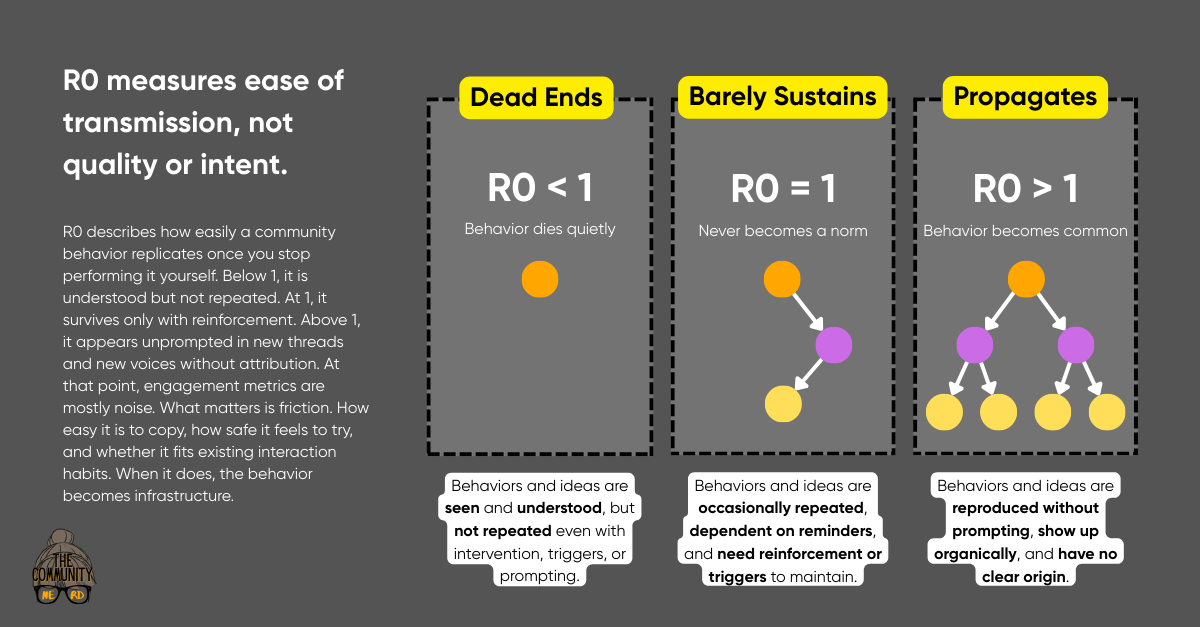
From a design perspective, this shifts where the risk actually lives which kind of tosses our usual mitigation strategies in with the used tissues. The danger is not that people disagree with the idea. The danger is that it requires too darn much effort, confidence, or social capital to repeat. If it only works when performed by moderators, leaders, or the original author, its R0 is effectively zero.
From a behavioral perspective, R0 lives in friction. How easy is it to do the thing once you have seen it done? Does it feel safe to imitate? Does it fit inside existing conversational habits, or does it demand a personality transplant?
From a measurement perspective, this is deeply annoying to us, data scientists, and anyone who loves data. Transmission is harder to see than participation. You are looking for second-order effects while steering clear of correlation without causation. We’re keenly looking for the language someone else adopts. The tone that shows up without prompting. The pattern that appears where you did not seed it.
This is often when practitioners feel uneasy. Because your influence becomes less legible at the same moment it becomes more real. You can no longer point to a single post or program and say, “That was the thing I did. It worked.” The work has moved into the background, where attribution gets fuzzy and credit gets scarce. We either sound like mad scientists or wizards trying to explain what has just happened and why it’s the best work we’ve done yet.
A community idea with a high R0 does not look dramatic. It looks boring in the best possible way. It blends in. It stops needing explanation. People do it without remembering where they learned it.
And once that happens, it is very hard to reverse. Not because you enforced it, but because your little virus learned how to survive on its own. Go virus, go!
Now back to sniffling.