


I am fairly certain every experienced community manager has had that moment of “The company did WHAT?” followed immediately by a very specific kind of dread. Never surprise. Always dread. The kind that comes from knowing the chaos is already in motion and is about to roll downhill.
You don’t yet know how chaotic it will get or how long it will last; only that community is about to feel it. Again. And somehow, more intensely than anywhere else.
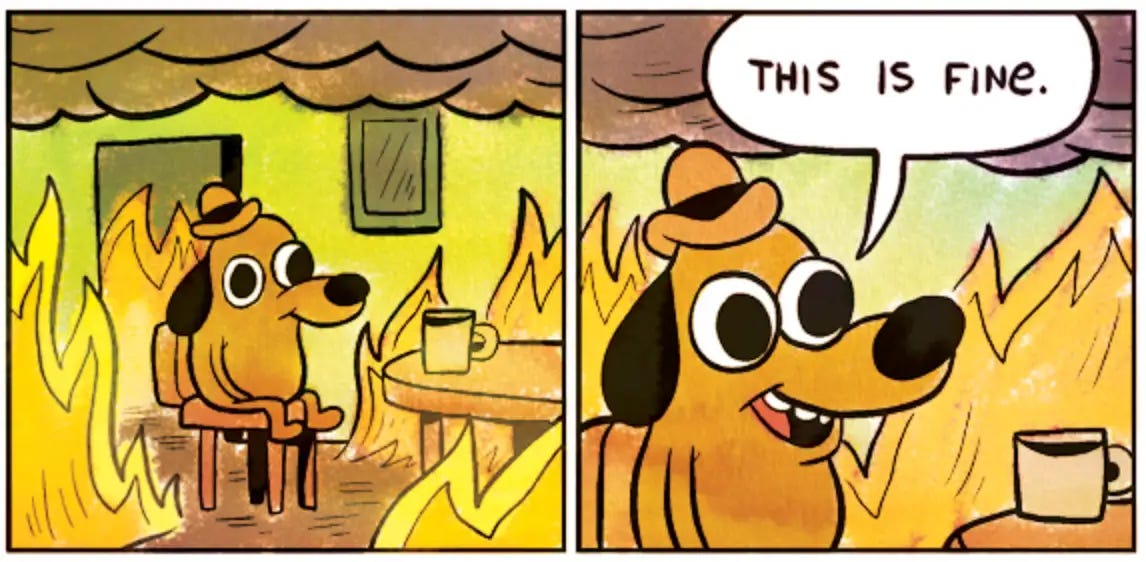
When this happens, it is tempting to frame the problem as community’s fault. We attract negativity. We’re too lenient. Our code of conduct isn’t strong enough. We should have prepared better. Jeez, did we design this mess? It looks and feels like a behavior problem of our own creation!
However, it rarely is. You can stop the self-loathing for now. (Do CM’s actually know how to not self-loathe? Asking for a friend.)
If your community suddenly feels louder but less helpful, chances are you do not have a community problem. You probably have a stage. A highly visible one at that, conveniently positioned exactly where pressure naturally flows when other paths stop working.
Great, huh?
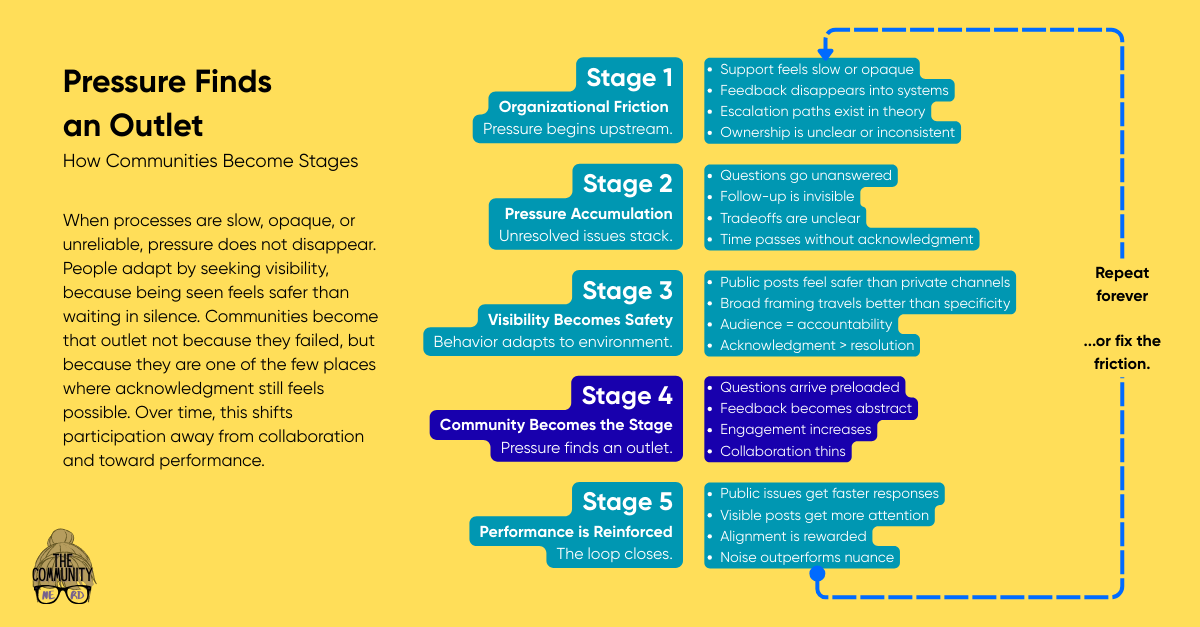
This shift almost never begins inside the community itself. It starts elsewhere in the organization, when people learn through experience that quieter channels are unreliable or too echo-y. Support feels slow or opaque. Feedback mechanisms feel ceremonial black holes. Escalation paths exist in theory but not in practice. Over time, people stop trusting process and start trusting visibility. They look for the surface most likely to acknowledge them. And community is often that surface (“stupid people skills and stupid empathy” mutters the burned out community professional before giving another chunk of their soul to a customer).
A truly healthy collaborative community rests on a simple belief: if I show up honestly, something useful will happen.
An unhealthy performative community operates on a different assumption: if I am visible enough, someone will have to respond.
At a glance, these two spaces can look remarkably similar. Both are active. Both involve posting, commenting, and engagement.
But, the difference lies in what those behaviors are optimized for and what they quietly replace.
One of the earliest signals of a ‘stage’ shows up in how questions are asked. Instead of opening space for exploration or learning, questions begin to arrive preloaded with conclusions.
“Why haven’t you released XYZ yet?”
“I already tried XYZ.”
“Don’t send me to XYZ.”
They are framed not to invite help, but to make a point. The question format becomes a delivery mechanism rather than a request for understanding. This is not bad faith. It is adaptation. When asking privately has not worked, people learn to ask publicly, and to ask in ways that travel.
Feedback changes shape in similar ways. Rather than being specific, directional, or grounded in concrete tradeoffs, it becomes abstract and broadly agreeable. The more generalized the feedback, the easier it is for others to rally around it. Agreement accumulates quickly, but resolution does not. Public validation begins to stand in for progress, even when nothing actually moves. If they can’t get help, they can at least get acknowledgement from peers.
Even help starts to feel different. Responses skew warm and affirming, but rarely go deeper. There are fewer clarifying questions, fewer attempts to iterate, and less appetite for productive friction. Helping becomes a visible signal of alignment rather than a collaborative effort to solve something together. Being seen responding matters more than doing the work. And trust me; we want to put out the fires, but there’s just too darn many.
Over time, the language of the space shifts. Phrases associated with escalation and accountability creep into peer conversations. Calls for ownership replace offers of contribution. The tone becomes more declarative and less exploratory. Activity may increase, but trust thins. The community feels busy, yet brittle, like it is holding more than it was designed to carry.
This is where teams often misread the situation. When a community becomes a stage, it is rarely the root problem. It is a symptom. It signals a broader system in which visibility has become safer or more effective than process. People are not performing because they want attention. They are performing because they believe it is the only reliable way to be heard. The community did not create this behavior. It inherited it.
Yayyy…. crawls under desk and starts sobbing.
A community can absorb that pressure for a while, but it cannot resolve it on its own. When it becomes the primary place where people seek acknowledgment, it gradually loses its capacity for collaboration. The work is not to quiet the stage or discipline the audience. The work is to understand why the stage exists in the first place.
In a healthy system, community is not where everything lands. It is where people come to think together, not because it is the loudest option available, but because it is the most constructive one.
Fan-freaking-tastic. What now? What if we don’t want to be the channel with the most engagement in ALL CAPS BECAUSE PEOPLE ARE REALLY ANGRY AND NOT AMUSED.
First up is realizing that most organizations do not intend to create performative behavior. In fact, many explicitly say they want thoughtful feedback, early signals, and honest dialogue. What they underestimate is how quickly people learn which behaviors actually get acknowledged and which quietly disappear.
Humans, man. Observant little things, eh?
Training does not happen through policy statements or values decks. It happens through response patterns. People watch what gets answered, how long it takes, and under what conditions. Over time (sometimes a very short time that lasts as long as a Google search), they adapt accordingly.
One of the most common training signals is opacity. When feedback enters systems that provide no visible acknowledgment or follow-up, people cannot tell whether it was read, considered, or ignored. In the absence of feedback about feedback, visibility becomes the proxy for impact. And if private channels feel like a void, public ones start to feel safer, even when they are noisier. It’s kind of the same dynamic that a lot of people feel safer in crowded places.
Speed reinforces this dynamic. When public posts receive faster responses than formal channels, people learn that urgency is manufactured through exposure. The lesson is subtle but powerful. If you want movement, make it visible. If you want accountability, attach an audience. Process begins to feel slow and optional, while performance feels efficient.
And, inconsistency makes the effect worse. When some issues raised through formal channels are addressed while others are not, people stop trusting the system as a whole. They look for patterns instead. Often, the only reliable pattern they can find is visibility. What is seen gets addressed. What is quiet waits indefinitely.
Organizations also unintentionally train performativity through abstraction. Broad feedback is easier to agree with publicly and harder to resolve privately. When nuanced, specific input leads to silence or delay, while generalized sentiment sparks discussion, people learn to flatten their feedback. Precision gives way to resonance. Agreement replaces progress.
Recognition systems play a role as well. If everything is smoldering, but that one thing looks extra on fire to community visitors and is gaining a lot of traction - chances are you’re going to want to put that out first. But are you rewarding undesired behavior with desired outcomes?
None of this requires bad intent. It is the predictable outcome of systems that prioritize manageability over legibility. When process is hard to see and outcomes are hard to trace, people reach for the only lever they can trust. They make noise.
Over time, this behavior spreads. New participants learn from observation, not instruction. They see what works and replicate it. Performance becomes the dominant participation mode, not because it is preferred, but because it is modeled and reinforced.
The irony is that organizations often respond by trying to quiet the noise. They ask for more structure, more discipline, more restraint. But performative behavior is not solved by suppression. It is solved by redesign.
People stop performing when they trust that quieter signals will be acknowledged, that specificity will be rewarded, and that contribution will lead somewhere predictable. Until then, visibility will continue to feel like the safest strategy available.
If organizations want collaborative communities, they must first build collaborative systems, embrace collaborative processes, and take accountability for where things land. Otherwise, the stage will keep reappearing, no matter where people are told to stand.